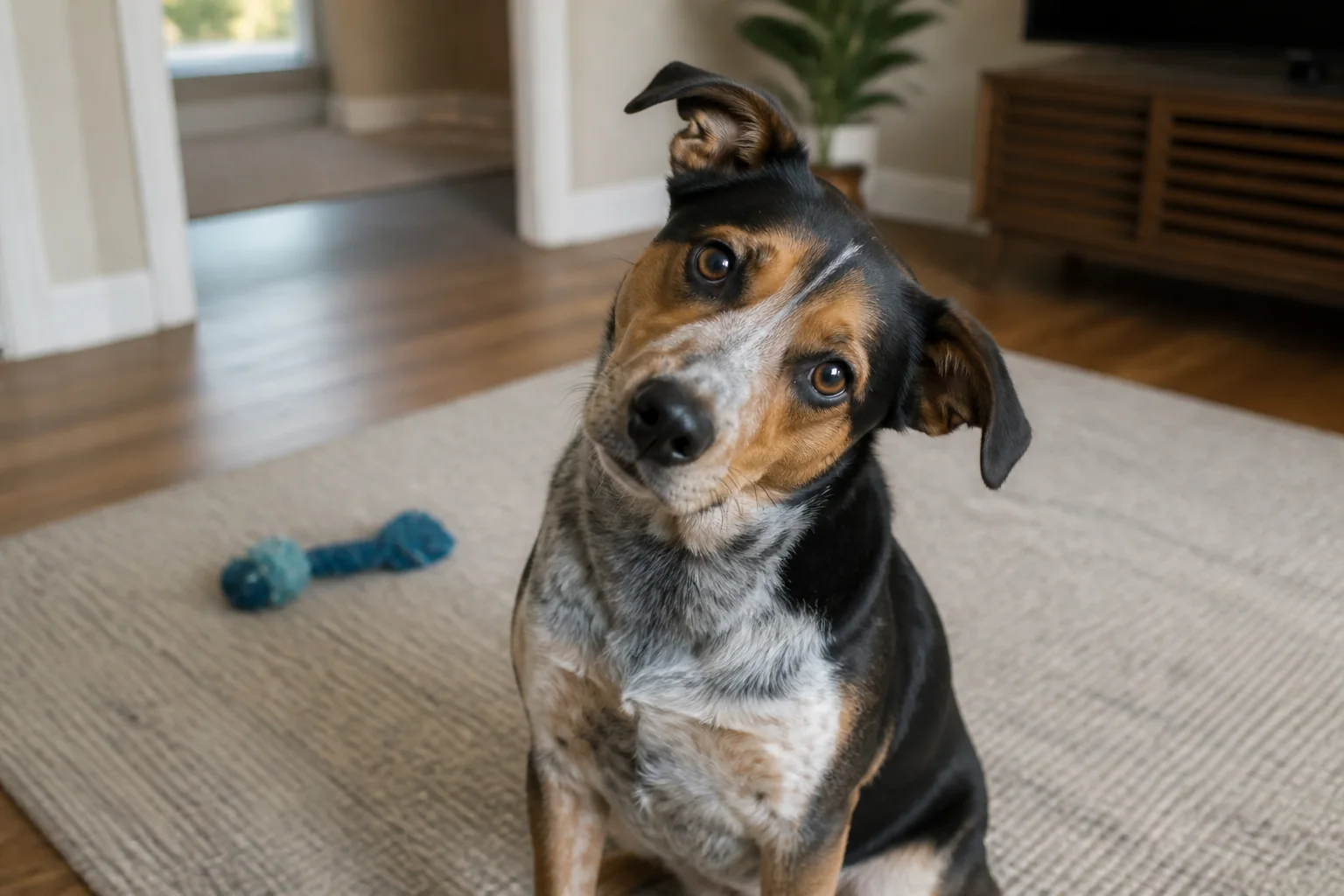
What did the head-tilt study find?
Researchers observed 40 family dogs: 33 typical learners and 7 “gifted word learners” who consistently knew object names. Across a three-month toy-name program, the gifted learners tilted more often when owners requested a familiar toy, and many dogs kept a stable preferred tilt direction across months.
The authors suggested a relationship between head tilting and processing relevant, meaningful stimuli. “Suggested” matters: the sample was small and the setup specific—the dogs heard trained toy names. The result cannot be stretched into “every tilt means they understood.”
Original study: Animal Cognition: An exploratory analysis of head-tilting in dogs.
Four reasons a dog may tilt their head
A familiar word, odd sound, or relevant cue may prompt a dog to reorient and pay closer attention.
Changing head position may help reorient a sound or view, although direct evidence for head tilting remains limited.
People often answer a tilt with laughter, attention, touch, or treats; rewarded behavior may become more frequent.
Some dogs tilt more and may favor one side over time. One moment does not need a confident label.
Additional context: American Kennel Club overview of visual, auditory, and learned factors.
Try a tiny, no-pressure observation
Do not manufacture noises or lure with treats. Just record the next five naturally occurring tilts: what was said or heard, where the dog looked, which side they chose, and what happened next. You may learn something about this dog without claiming a rule about all dogs.
- Write the trigger without guessing intent.
- Notice ears, eyes, body tension, and approach or retreat.
- Look for repetition around a word, person, or situation.
- Let the interaction end when the dog disengages.
When is a head tilt a health concern?
A brief, responsive tilt during listening is different from holding the head to one side without an obvious trigger. Contact a veterinarian promptly for a sudden or persistent tilt, especially with stumbling, circling, falling, vomiting, drooling, disorientation, or unusual eye movement. Ear or vestibular problems can affect both head position and balance.
Do not shake the dog or probe deep into the ears to test the tilt. Record a video from a safe distance and tell the veterinarian when it began, how long it lasted, and what came with it.
Dog head tilting: common questions
Why does my dog tilt their head when I talk?
They may be focusing, processing a familiar word, or reorienting toward a sound. Vision, hearing, and previously rewarded attention may all contribute; there is no single explanation for every dog.
Does a tilt mean my dog understood me?
Not by itself. A small study found more tilting among dogs who knew toy names when relevant words were used, but that does not prove any dog understood a full sentence.
When should I worry?
Contact a veterinarian promptly if the tilt is sudden, persists, or comes with imbalance, circling, vomiting, disorientation, or unusual eye movement.