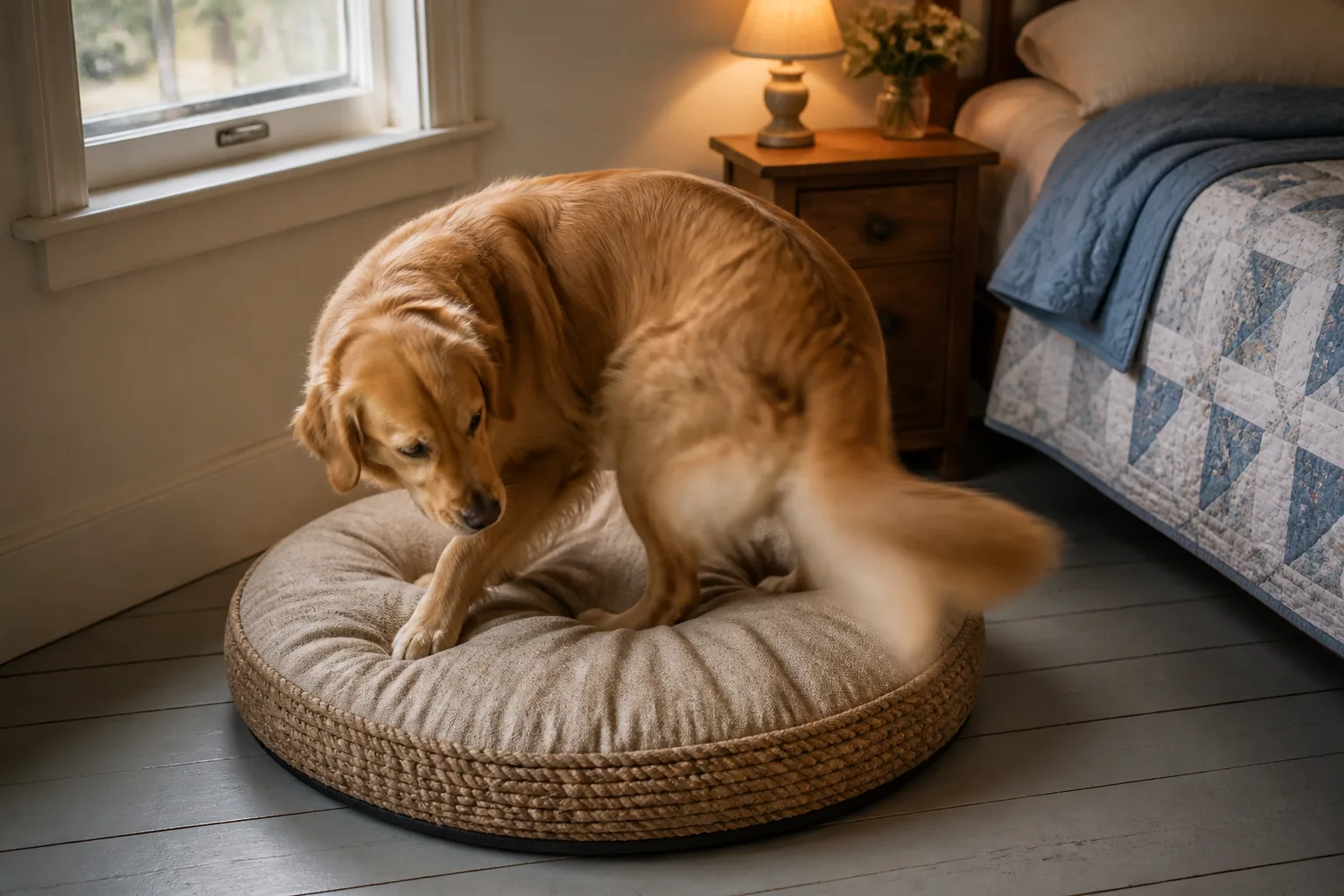
When is bedtime circling ordinary?
Watch the full sequence rather than counting circles alone. A dog approaches a familiar bed, sniffs, turns once or twice, perhaps paws the blanket, then softens and sleeps. That is a stable ritual with a clear end. Another dog may never turn, while one repeats the same sequence every night.
The surface can change the ritual. A new bed, slippery floor, warm blanket, or tight space may require more adjustment. Improving the environment is more useful than stopping the movement.
Why might dogs retain the circling ritual?
Common explanations include flattening vegetation or bedding, surveying the area, choosing a direction for temperature or airflow, and completing a settling sequence retained from canine ancestors. These ideas are plausible, but a circle cannot reveal one dog’s exact thought.
Veterinary source: VCA Animal Hospitals: why dogs turn before lying down.
Run a one-minute bed check
If an older dog changes position frequently or suddenly prefers firmer or softer support, record the surface and timing for a veterinary discussion. Buying a bed labeled “orthopedic” is not a substitute for assessment.
When can circling signal difficulty or pain?
VCA notes that dogs in pain may circle excessively while trying to find a comfortable position; arthritis, back trouble, or spinal problems can make lying down difficult. The American Animal Hospital Association pain checklist also includes difficulty finding a comfortable position and circling before lying down among changes to read with other signs.
Call a veterinarian when circling accompanies limping, stiffness, panting, crying, reluctance on stairs, loss of balance, disrupted sleep, or a sudden change. Persistent circling in one direction outside the bedtime context also needs prompt assessment.
Pain reference: American Animal Hospital Association: signs of pain in dogs and cats (PDF).
Bedtime circling: common questions
How many circles are normal?
There is no universal number. A stable turn or two followed by easy settling matters more than the count. Repeated circling without finding rest is the useful warning.
Should I stop the circling?
Do not stop an ordinary settling ritual. Keep the bed stable, large enough, and non-slip. If it becomes repetitive or uncomfortable, record a video and call a veterinarian rather than scolding.
What if an older dog suddenly circles more?
Check for stiffness, difficulty rising, night waking, or avoiding stairs. A sudden change may relate to pain, sensory change, or neurological trouble and should be evaluated.