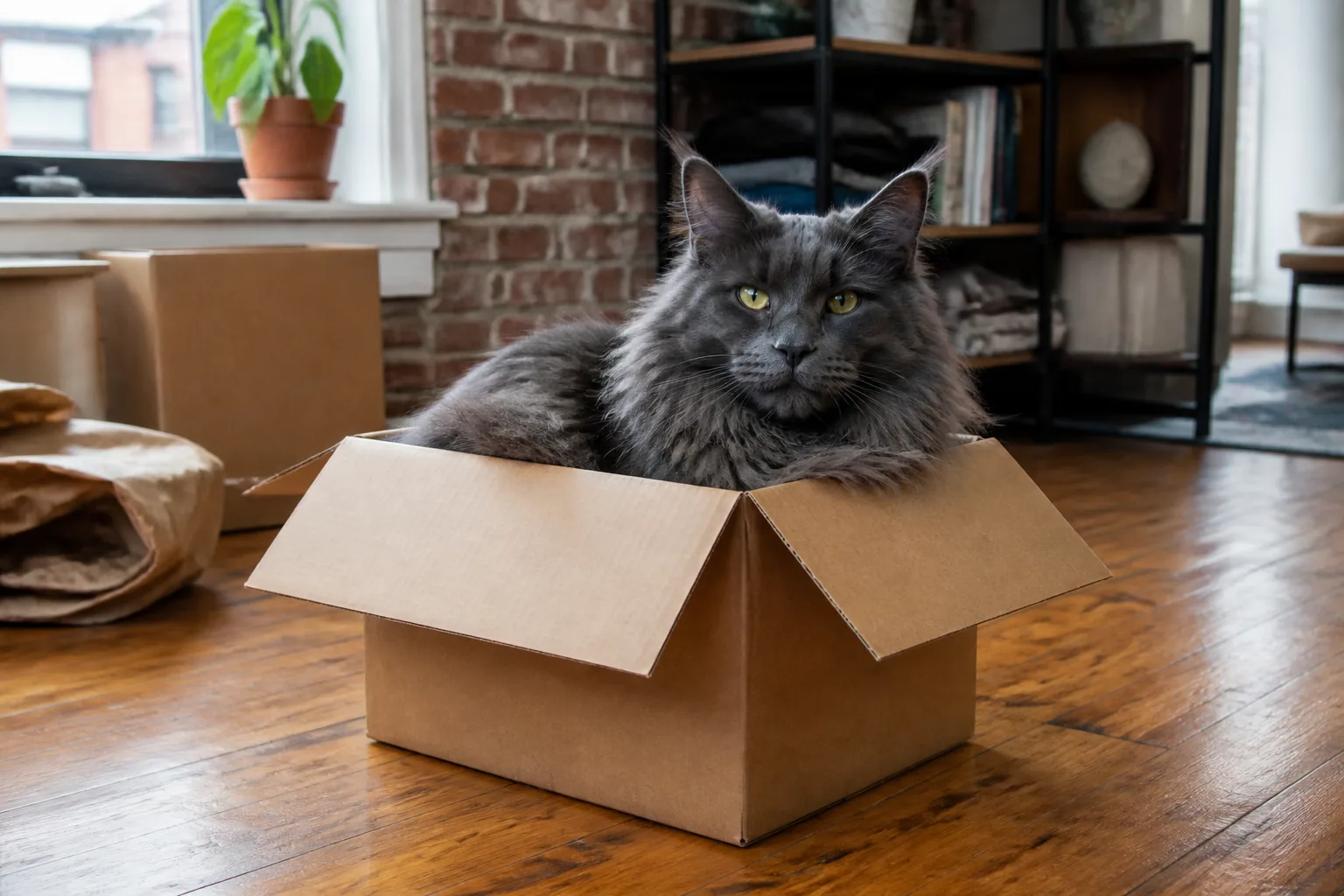
Why is a cardboard box attractive to a cat?
Four boundaries reduce the directions a cat must monitor, while an opening lets the cat observe before choosing to emerge. For a cat new to a home, facing visitors, or seeking rest, the option to retreat can be valuable.
Cardboard has scent and texture, can hold familiar household odor, and changes with scratching or pressure. Another cat may prefer a perch, covered bed, under-chair space, or open cushion. A box is one environmental choice, not a universal solution.
What did hiding-box studies find?
A 2014 Dutch shelter study randomized 19 newly arrived cats: 10 received a hiding box and 9 did not, with observations across 14 days. The box group had lower behavioral stress scores on days 3 and 4 and reached a stable level sooner. The sample was small and the setting was shelter quarantine.
Another randomized controlled trial followed 23 shelter cats for 12 days. Stress fell in both groups, but cats with boxes reached a lower steady behavioral-stress level about seven days earlier; boxes did not significantly change weight loss. Hiding choice may support behavioral adaptation, but it is not a cure for every welfare or health problem.
Research: Applied Animal Behaviour Science: hiding boxes and shelter-cat stress · Randomized trial: hiding boxes, stress, and body weight.
Set up a safer cat box in five steps
- Choose a clean, dry box without chemical or food residue.
- Remove staples, loose tape, plastic wrap, cord loops, and sharp edges.
- Place it on a stable floor away from heaters, flames, blind cords, and unsafe heights.
- Keep the opening clear; never place the cat inside or block the exit.
- Replace it when damp, heavily chewed, or structurally soft.
In a multi-cat home, distribute resources so one cat cannot guard the only entrance. Hiding places, water, food, and litter boxes should all have safe approaches and exits.
It is fine if your cat ignores the box
Do not repeatedly place a cat in a box for a photo. Leave it in a quiet but accessible spot for 24–48 hours and let the cat investigate. Choosing a windowsill, cat tree, or under-bed space may meet the same need for height, cover, or distance in another way.
Persistent hiding alongside reduced appetite, litter-box change, pain, or sudden withdrawal from household interaction is not simply “loving the box.” Record the change and contact a veterinarian.
Cats and boxes: common questions
Is a smaller box always better?
No. Close boundaries may feel secure to some cats, but the box must remain stable and allow free entry and exit. Offer two sizes and let the cat choose.
Can a box reduce stress?
Randomized shelter studies found faster behavioral-stress reduction for some newly arrived cats. A home is different, so treat a box as an optional resource, not a treatment.
Should I put a blanket inside?
Try a thin clean layer that cannot snag claws, or leave the cardboard bare. Follow the cat’s preference and keep materials dry, flat, and free of loose threads.