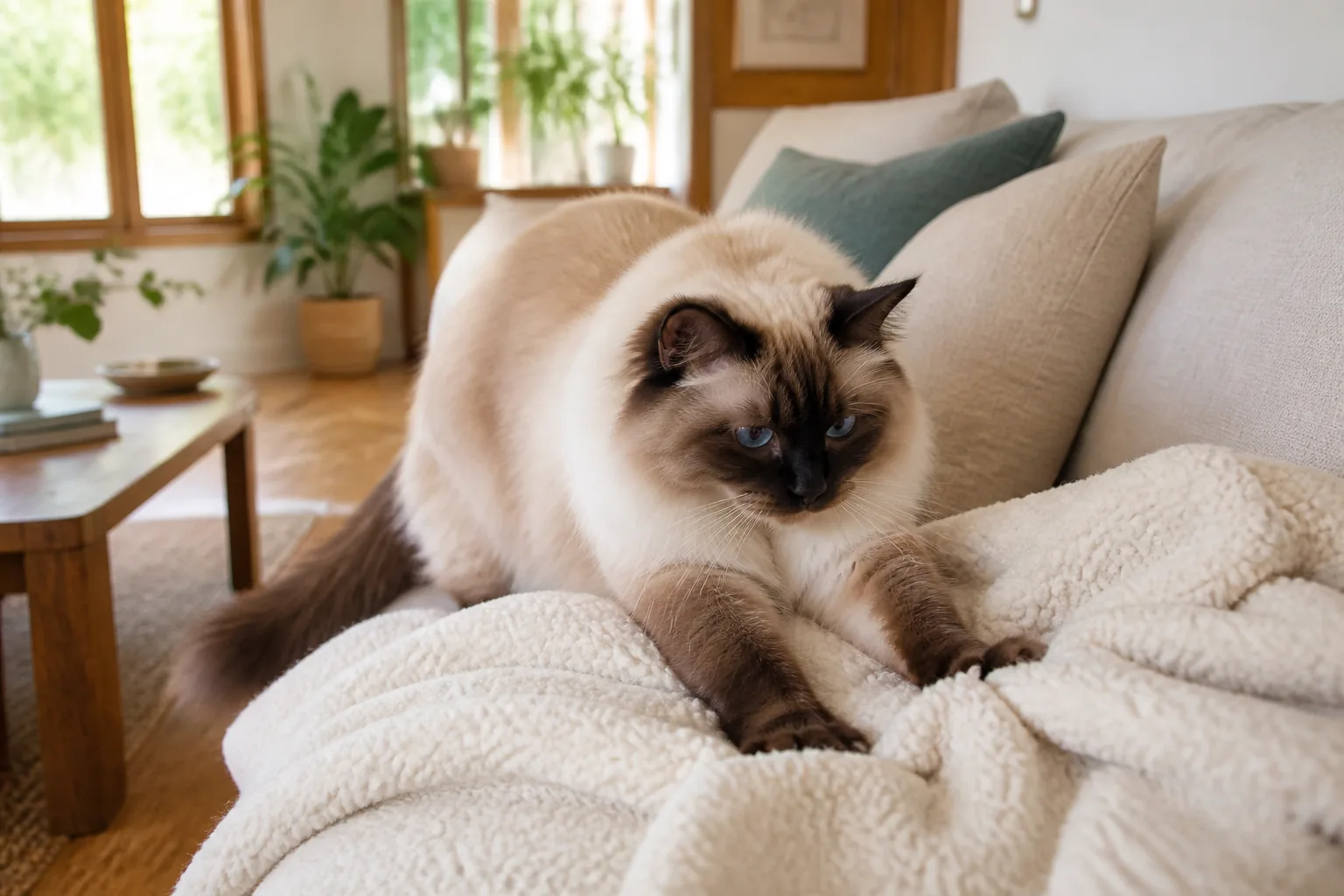
Why do cats knead?
The clearest starting point is kittenhood: nursing kittens alternate pressure with their front paws. Why an adult keeps the movement may not have one answer. The American Animal Hospital Association lists comfort, arranging a soft resting place, affectionate interaction, and scent marking from the feet among common explanations.
Several explanations can overlap. One cat may knead a blanket, circle, settle, and purr; another may do it only on one person’s lap. Instead of translating the behavior into one fixed human sentence, notice posture, setting, and what happens before and after.
Reviewed source: AAHA: Is my cat’s kneading normal?.
Why does my cat knead me?
Your lap may combine several useful qualities: warm, soft, familiar, and often paired with calm attention. Kneading may happen as a cat settles to sleep or become part of a repeated interaction with you. The context matters to the cat, but it does not prove a single story such as “the cat thinks you are their mother.”
Soft eyes, a relaxed body, and voluntary approach say more about comfort than the paws alone.
Do not hold the cat in place or make them continue; let the cat start and end close contact.
What if the claws hurt or snag fabric?
Do not yell, spray, or punish. Kneading is natural, and punishment can turn a calm moment into a stressful one. Keep a thick, washable blanket nearby; when kneading begins, place it gently over your lap or invite the cat onto a familiar soft spot.
- Offer one thick blanket as the regular kneading spot.
- Trim nails routinely using guidance from a veterinarian or qualified groomer.
- Provide suitable scratching surfaces so scratching has an appropriate outlet too.
- If the cat resists being moved, allow them to leave rather than competing for the spot.
When can a change in kneading matter?
Kneading itself is usually not concerning, but “different from normal” is worth recording. Contact a veterinarian if a sharp increase or disappearance comes with hiding, appetite changes, limping, touch sensitivity, over-grooming, or other behavior changes. Cats may also seek familiar soothing actions during stress or discomfort, so purring or kneading alone cannot prove comfort.
Additional veterinary context: VCA Animal Hospitals on kneading and self-soothing.
Cat kneading: common questions
Why does my cat knead me?
Your lap may be warm, soft, familiar, and associated with safety and attention. Kneading can be a comfort or social behavior, but it is not a code with one fixed meaning.
Should I stop my cat from kneading?
Usually no. If claws hurt or snag fabric, place a thick blanket between you and the cat and redirect gently without punishment.
When can kneading be a concern?
Ask a veterinarian about a sudden marked change, especially with hiding, appetite loss, limping, painful touch, or other unusual signs.