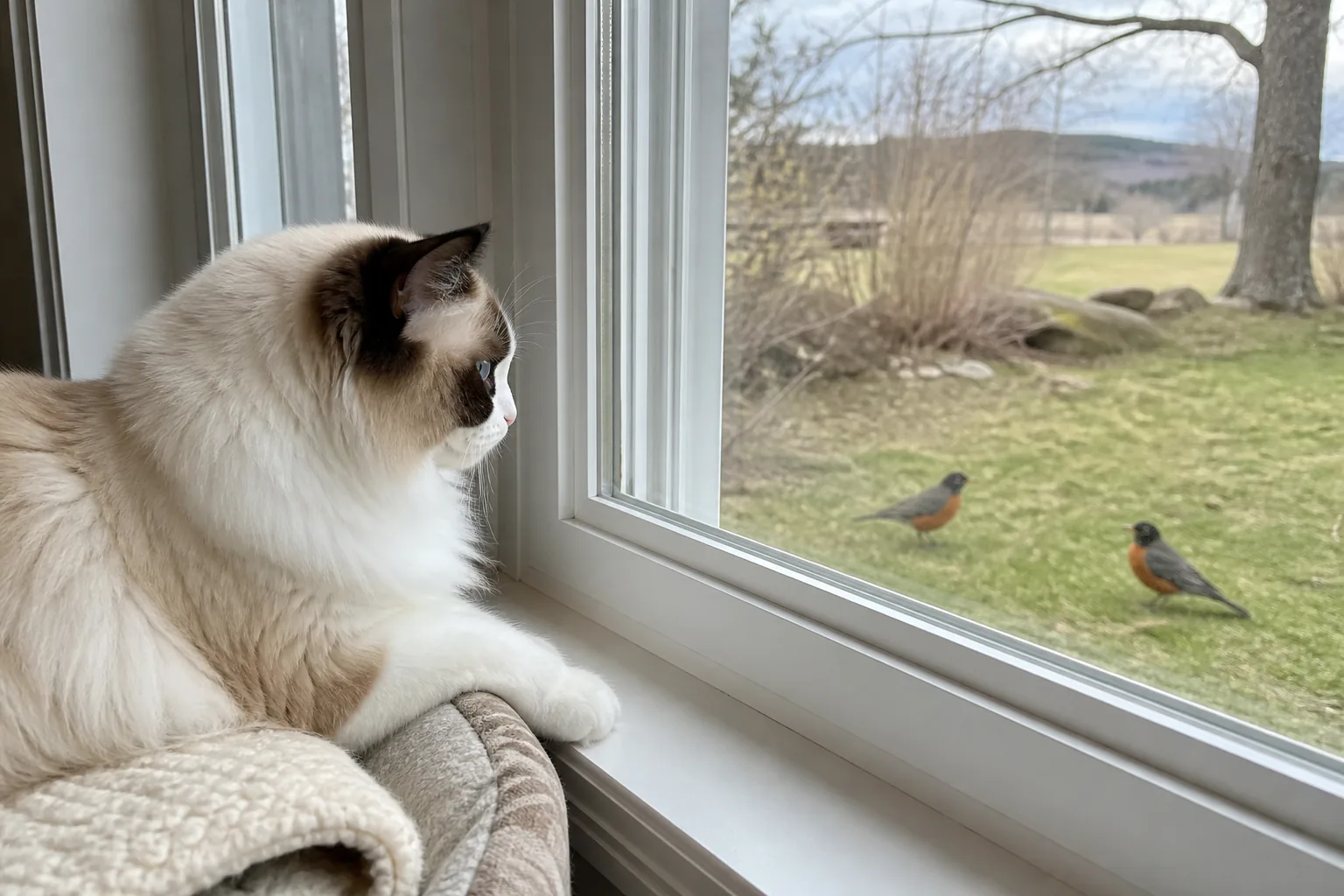
What do cat chirps and chatters look like?
People often call a short high sound a chirp or trill, and a rapid series of quiet sounds with fast jaw movement a chatter. Everyday labels are not perfectly consistent, so describing the sound, mouth movement, duration, and target is more useful than relying on one name.
Cats Protection notes that chatter often appears when a cat sees birds, squirrels, or insects and may accompany an intense stare, a lowered body, or tail-tip movement. VCA's guide to cat sounds likewise emphasizes reading vocalization with body language and context.
Sources: Cats Protection: why cats chatter and chirp at birds · VCA: meaning of cat sounds.
Why make the sound? Plausible ideas and what remains unknown
The safest observation is that the sound commonly appears with a prey target and intense attention. Predatory arousal may activate jaw and vocal movements; frustration may also be present when glass prevents approach. The sound alone cannot tell us which factor dominates.
“The cat is imitating birds to lure them” is a popular story, but strong evidence that domestic cats chatter specifically to mimic or attract birds is lacking. It can be discussed as an interesting hypothesis, not a proven fact.
A five-step safe window-watching and play checklist
- Check that the window and screen lock securely; an ordinary screen may not withstand a cat lunging into it.
- Provide a stable sill mat or cat tree away from blind cords, breakable objects, and furniture that can tip.
- Keep the cat indoors and birds physically separated; do not encourage hunting wildlife.
- After watching, use a wand or toss toy for a short stalk-chase-catch play sequence.
- Finish with a toy the cat can catch or a small portion of regular food; do not punish vocalizing.
If window activity leads to prolonged pacing, repeated lunging, or difficulty settling, shorten the viewing period, adjust visual access, and schedule play before birds usually appear.
When does a new sound need veterinary assessment?
Occasional chatter only while watching birds, followed by a quick return to normal activity, is different from a medical problem. Contact a veterinarian promptly if a new sound occurs without birds or play, or comes with drooling, bad breath, pawing at the mouth, difficulty chewing, reduced appetite, panting, coughing, or labored breathing.
Record a short video and note the time, duration, and what happened just before it. A video cannot replace an examination, but it is more useful to a veterinarian than “my cat makes a strange sound.”
Cat chirping at birds: common questions
Is my cat chattering because of frustration?
Frustration may contribute, but the sound alone cannot confirm it. Predatory excitement, intense attention, and inability to reach the target may overlap. Notice whether the cat can settle afterward.
Is my cat imitating a bird?
That is a popular hypothesis, but strong evidence that domestic cats chatter to mimic or lure birds is lacking. It is more accurate to say the sound is strongly associated with watching prey.
Should I stop my cat from watching birds?
Usually not. With a secure window, physical separation, and a cat who settles afterward, bird watching can be part of enrichment. Repeated lunging or prolonged agitation calls for changes to duration and setup.